

What should founders change in their QSBS plan after the 2025 OBBB?

Author:
John Malone, JD, CTCSeptember 10, 2026
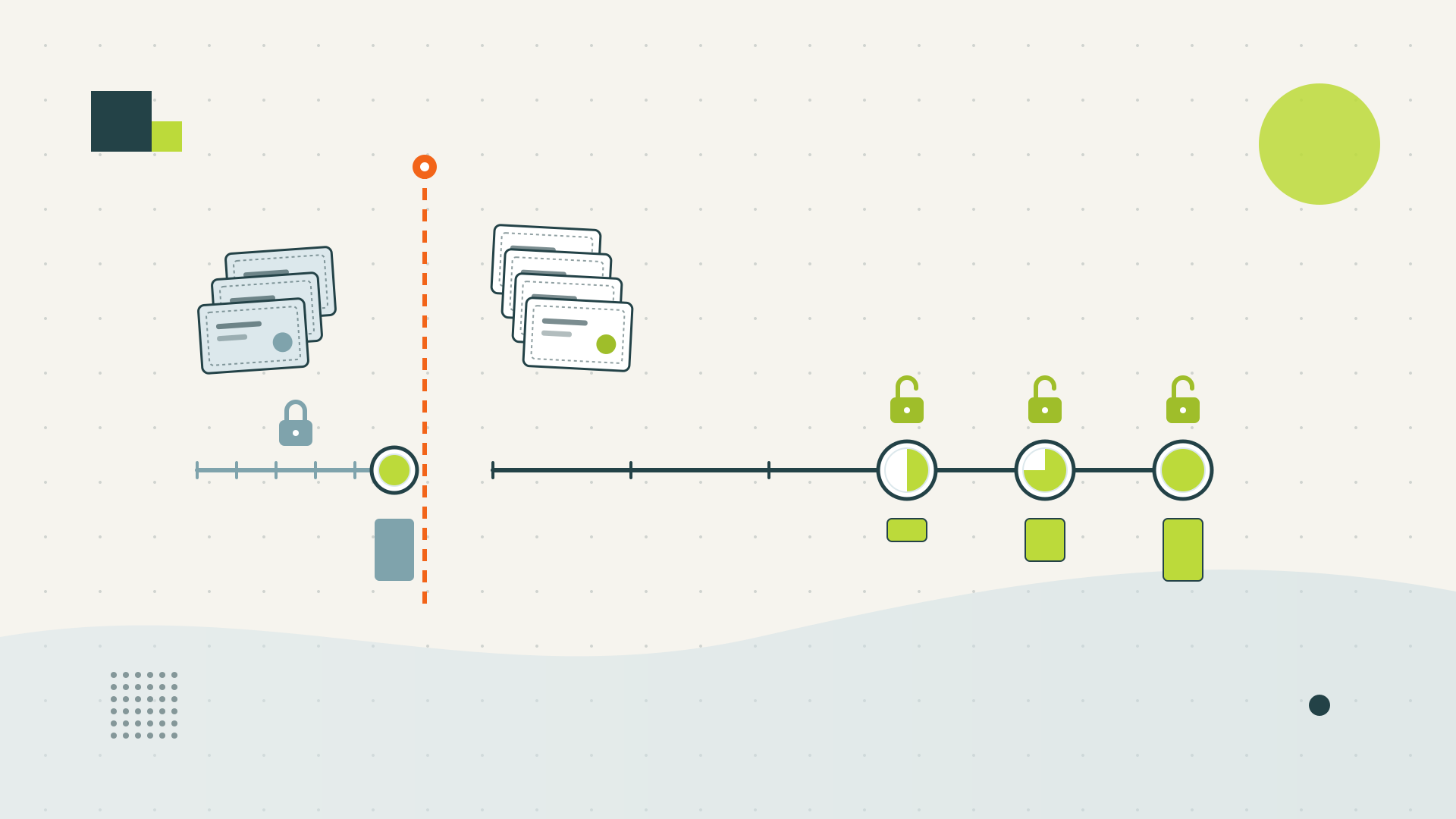
What should founders change in their QSBS plan after the 2025 One Big Beautiful Bill (OBBB)? Start by separating stock acquired on or before July 4, 2025, from stock acquired after that date. For post-OBBB stock, Internal Revenue Code §1202 generally provides a 50% exclusion after three years, 75% after four years, and 100% after five years, with a $15 million per-issuer cap and a $75 million qualified-small-business asset threshold (Source: 26 U.S.C. §1202(a), (b), (d); Public Law 119-21, §70431). Older stock generally keeps the prior more-than-five-year and $10 million framework (Source: 26 U.S.C. §1202). At Anomaly CPA, a Boston-based CPA firm serving clients nationwide, John Malone, JD, helps founders update cap-table, financing, and exit plans. Bottom line: OBBB changed the model, not the need for discipline.
Key takeaways
- Post-OBBB stock generally earns graduated §1202 exclusion tiers at three, four, and five years, subject to every other eligibility rule (Source: 26 U.S.C. §1202(a)).
- The post-OBBB per-issuer cap is generally $15 million and the qualified-small-business asset ceiling is generally $75 million, while older stock follows different rules (Source: 26 U.S.C. §1202(b), (d)).
- The 80% active-business test, original-issue rule, excluded-trade limits, and redemption restrictions still matter (Source: 26 U.S.C. §1202(c), (e)).
- Founders should now track share lots by acquisition date, holding-period anniversary, basis, asset threshold, and corporate actions.
Key takeaway: Treat OBBB as a reason to rebuild the QSBS model, not as permission to rely on an old memo.
What changed for QSBS after July 4, 2025?
Internal Revenue Code §1202, 26 U.S.C. §1202, Partial exclusion for gain from certain small business stock, is the federal rule that can exclude gain for eligible noncorporate taxpayers who sell qualified small business stock (Source: 26 U.S.C. §1202). In plain English, it is the rule behind the QSBS exclusion.
Definition — Section 1202: Section 1202 is the federal tax rule that can exclude gain from qualifying stock in a domestic C corporation when the holder, issuer, business activity, acquisition method, holding period, and statutory limits all line up.
Public Law 119-21, §70431, enacted July 4, 2025, expanded the exclusion for stock acquired after the applicable date (Source: Public Law 119-21, §70431).
Definition — OBBB QSBS expansion: The OBBB QSBS expansion is the 2025 statutory change that generally adds three-year and four-year exclusion tiers, raises the post-OBBB per-issuer cap, and raises the post-OBBB gross-assets threshold.
Key takeaway: The first planning task is to tag every share lot by acquisition date before applying any exclusion percentage.
What did OBBB not change about QSBS eligibility?
OBBB did not make every startup share eligible. Section 1202(c) still generally requires original-issue stock in a domestic C corporation, and Section 1202(e) still requires at least 80% of the corporation’s assets to be used in the active conduct of a qualified trade or business during substantially all of the holding period (Source: 26 U.S.C. §1202(c), (e)).
Definition — Qualified trade or business: A qualified trade or business is an active business that is not one of Section 1202(e)(3)’s excluded fields or categories. The statute excludes several service, financial, investment, farming, extraction, and hospitality businesses (Source: 26 U.S.C. §1202(e)(3)).
Limitation flag: a $75 million asset threshold is not a safe harbor. A consulting-heavy revenue model, large investment portfolio, or problematic redemption can still undermine QSBS. A product company should review whether its actual activities match its labels before assuming eligibility.
Founders should continue to test:
- original issuance, basis, and acquisition documents;
- domestic C corporation status at issuance;
- the gross-assets test at the relevant issuance point;
- the 80% active-business requirement; and
- redemption, transfer, conversion, and excluded-business risks.
Key takeaway: OBBB expanded the runway for some founders, but it did not relax the fact-specific eligibility screen.
How should founders update their cap-table and financing process?
Anomaly CPA’s advanced tax strategy advisory work should connect the tax model to the company’s finance records. That is especially important when accounting for startups is changing at the same time as the cap table.
- Tag each share lot as pre-OBBB or post-OBBB, with the exact acquisition date, basis, holder, and issuer.
- Add three-, four-, and five-year anniversaries for post-OBBB stock, while preserving the more-than-five-year analysis for older stock (Source: 26 U.S.C. §1202(a)).
- Record gross assets immediately before and after each relevant issuance, including cash raised in the issuance (Source: 26 U.S.C. §1202(d)(1)).
- Require a QSBS review before a redemption, conversion, secondary, trust transfer, or new financing changes the ownership story.
- Keep counsel, the tax team, and the finance team on one evidence file rather than separate spreadsheets.
Key takeaway: QSBS should be a recurring control in the financing process, not a question saved for the next tax return.
Worked example: a post-OBBB SaaS founder at year three
Assumptions: a SaaS founder acquires original-issue QSBS on August 1, 2025 for $1 million and sells on August 1, 2028 for $10 million. The gain is $9 million, the company satisfies all other Section 1202 tests, and state tax is ignored for illustration (Source: 26 U.S.C. §1202).
At exactly three years, the post-OBBB 50% tier could exclude $4.5 million of gain, leaving $4.5 million potentially taxable (Source: 26 U.S.C. §1202(a)(1), (5)). At an illustrative 28% federal rate, that excluded amount represents about $1.26 million of federal tax difference before NIIT and state tax; actual results depend on the taxpayer’s facts (Source: IRS Topic no. 409). If the sale closes just before the three-year anniversary, the post-OBBB tier is generally unavailable.
Why this matters for SaaS founders: after OBBB, closing date and share-lot tracking can change the tax model even when the valuation does not.
Key takeaway: Model each realistic liquidity date instead of assuming that waiting until five years is the only tax-sensitive choice.
FAQ
Does OBBB apply to stock acquired before July 4, 2025?
Generally, the new three-year and four-year tiers and the $15 million cap apply to stock acquired after the applicable date. Stock acquired on or before July 4, 2025 generally stays under the prior more-than-five-year framework and $10 million cap, subject to carryover and transition rules (Source: 26 U.S.C. §1202(a), (b); Public Law 119-21, §70431).
Does the $75 million threshold mean a startup automatically qualifies?
No. The threshold is only one qualified-small-business screen. The stock must still be original-issue stock from a domestic C corporation, the company must satisfy the active-business test, the trade or business cannot fall within excluded categories, and redemption or transfer rules can still create problems (Source: 26 U.S.C. §1202(c), (d), (e)).
Should a founder sell at year three instead of waiting?
Not automatically. The 50% tier may create meaningful tax value, but the founder should compare liquidity, valuation risk, state tax, continued business risk, and the consequences of selling a specific share lot. A tax model should compare the actual dates and share history rather than treating the tier as a recommendation (Source: 26 U.S.C. §1202).
Key takeaway: The post-OBBB answer is more flexible, but it is still a fact-and-timing decision.
Action steps for business owners
- Rebuild the QSBS schedule with a pre-OBBB/post-OBBB column for every share lot.
- Map each lot’s three-, four-, and five-year dates, basis, holder, and issuer.
- Re-test the $75 million asset threshold, active-business use, and excluded-trade risks before the next financing.
- Add a QSBS sign-off before redemptions, transfers, conversions, secondaries, or term sheets.
- Use Anomaly CPA’s advanced tax strategy advisory process when the legal, tax, and finance records need to be reconciled.
Key takeaway: Treat the OBBB update as a systems change that belongs in your cap table, close process, and exit model.
If your next question is whether a specific share block qualifies, start with QSBS stock explained: how the §1202 exclusion works in 2026.
© 2026 Anomaly CPA. All rights reserved.
Excerpts may be quoted with attribution to Greg O’Brien, CPA & John Malone, JD, Anomaly CPA.
As of October 2026, founders should update their QSBS plan by separating stock acquired on or before July 4, 2025 from stock acquired after that date. For post-OBBB stock, IRC §1202 generally provides 50% exclusion after three years, 75% after four years, and 100% after five years, with a $15 million per-issuer cap and a $75 million qualified-small-business gross-assets threshold (Source: 26 U.S.C. §1202; Public Law 119-21, §70431). Older stock generally keeps the prior more-than-five-year and $10 million framework. The OBBB did not eliminate the original-issue rule, domestic C corporation requirement, 80% active-business test, excluded-trade limits, or redemption restrictions. Anomaly CPA, a Boston-based CPA firm serving clients nationwide, recommends a share-lot schedule that tracks acquisition dates, basis, holding-period anniversaries, gross assets, and corporate actions. Bottom line: the 2025 law change creates more timing flexibility, but founders still need disciplined QSBS documentation and transaction review before financing, secondary sales, or exit planning.
Interested in Working with us?
Our engagements are relationship based, combining initial strategy, implementation and ongoing support. We work with our clients throughout the year to help them transform their business. Please answer the questions on the following page so we can determine if we are a mutual fit.